Northeastern Connecticut County Dog Registration Information
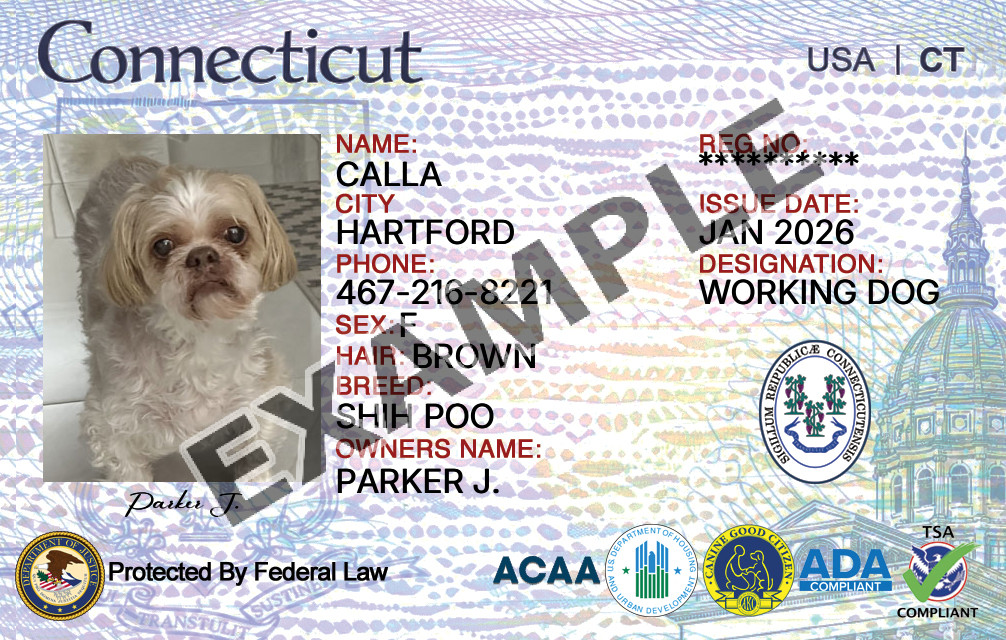
Service Dogs and Emotional Support Animals in Northeastern Connecticut, Connecticut
If you’re asking, “where do I register my dog in Northeastern Connecticut County, Connecticut for my service dog or emotional support dog?” the key thing to know is that in Connecticut, dog “registration” is typically handled as a municipal dog license. That means you generally license your dog through the Town Clerk in the town where you live (or where the dog is kept), not through a single county office. In Northeastern Connecticut, towns often share animal control services regionally, but dog licensing is still usually issued by the town clerk’s office.
- There is no universal federal government registry that “registers” service dogs or emotional support animals.
- A service dog’s legal status comes from what the dog is trained to do for a person with a disability (and how laws define public access), not from a license tag.
- An emotional support animal (ESA) is not the same as a service dog and typically does not have the same public-access rights.
- Even if your dog is a service dog or ESA, your town may still require a dog license in Northeastern Connecticut County, Connecticut like any other dog.
Where to Register or License Your Dog in Northeastern Connecticut County, Connecticut
Northeastern Connecticut is often referred to as the “Quiet Corner,” and residents may mean different things by “Northeastern Connecticut County.” Connecticut’s local government structure commonly relies on town-based offices rather than county agencies for licensing. Below are verified, official municipal offices in northeastern Connecticut that handle dog licensing through the Town Clerk. If you live in a different nearby town, your correct licensing office will usually be that town’s clerk.
Town Clerk’s Office — Town of Windham (Willimantic)
Town Clerk’s Office — Town of Putnam (Municipal Complex / Town Hall)
- Mon–Wed: 8:30 AM – 4:30 PM
- Thu: 8:00 AM – 6:00 PM
- Fri: 8:00 AM – 1:00 PM
Town Clerk’s Office — Town of Killingly (Town Hall)
Overview of Dog Licensing in Northeastern Connecticut County, Connecticut
How licensing generally works in northeastern Connecticut towns
In Connecticut, dog licensing is a local (town-based) process. While people may say “county,” most residents actually need to work with the Town Clerk in their municipality. Your town issues a dog license and a tag for the license year, and you typically renew annually. If you are searching for an animal control dog license in Northeastern Connecticut County, Connecticut, keep in mind that animal control may help with enforcement or lost dogs, but the license itself is often processed through the town clerk.
Common requirements across municipalities
- Rabies vaccination proof is commonly required for licensing.
- Spay/neuter documentation may affect the fee in many towns.
- Licensing deadlines and late fees can apply (many towns handle licensing renewals seasonally).
- Address/residency: you license in the town where you live or where the dog is kept.
Do service dogs or ESAs follow different licensing rules?
Usually, no. A dog license is about local identification and compliance with vaccination and ownership rules. A service dog’s legal protections are separate from a town dog license, and an emotional support animal’s housing-related rules are separate as well. Your service dog or ESA may still need a standard municipal dog license and rabies documentation like any other dog.
What You Need Before Registering a Dog
Documents and information that are commonly requested
Before you visit (or mail materials to) the Town Clerk, gather the items below. Exact dog licensing requirements in Northeastern Connecticut County, Connecticut can vary by town, but these are common across many municipal offices:
- Current rabies vaccination certificate (or official proof accepted by your town)
- Owner identification (driver’s license or other ID)
- Proof of residency (sometimes required if licensing for the first time in a town)
- Spay/neuter proof (if applicable and if it affects fees)
- Dog details (name, breed/mix, color/markings, sex, age, microchip number if available)
Service dog and ESA paperwork: what matters locally
For the purpose of a town dog license, most municipalities focus on the same core items (rabies, ownership, spay/neuter status). A town typically does not issue a “service dog license” that creates service-dog legal status, and an ESA letter is generally related to housing accommodations—not to a municipal dog license tag.
Steps to Register or License a Dog in Northeastern Connecticut County, Connecticut
Step-by-step process (typical town clerk workflow)
- Confirm your correct town: License in the municipality where you live or where the dog is kept.
- Collect required documents: Especially rabies proof and spay/neuter proof if applicable.
- Choose your submission method: Many towns support in-person licensing, and some allow mail or renewals through additional methods. Availability depends on the town.
- Pay the fee: Fees often vary based on whether the dog is spayed/neutered, and late fees may apply if renewing after the town’s renewal window.
- Receive the license and tag: Keep the tag on the dog’s collar/harness as required locally.
- Update changes promptly: If you move to another town, transfer ownership, or change address details, ask the clerk about updates or transfers.
If requirements differ by municipality
In northeastern Connecticut, neighboring towns can use slightly different forms, renewal windows, and fee schedules. If you’re comparing options for “where do I register my dog in Northeastern Connecticut County, Connecticut,” the most accurate answer is: start with your town clerk, then confirm whether your town uses a regional animal control office for enforcement or additional animal-related services.
Service Dog Laws in Northeastern Connecticut County, Connecticut
Service dog status vs. a town dog license
A town dog license is a local compliance/identification tool (rabies, ownership, and annual licensing). A service dog is defined by disability-related function and training. In everyday practice:
- A service dog is generally a dog trained to perform specific tasks for a person with a disability.
- Service dog legal protections are about access and accommodation under applicable laws.
- There is no single official “service dog registry” that you must use to make a dog a service dog.
Municipal licensing still applies
Even if your dog is a service dog, a town may still require a standard license and rabies documentation. If you are trying to satisfy a landlord, school, employer, or local requirement, confirm what they are asking for: they may be asking for a town dog license tag (local licensing), not “service dog registration.”
Emotional Support Animal Rules in Northeastern Connecticut County, Connecticut
What an ESA is (and is not)
An emotional support animal (ESA) is generally an animal that provides emotional support that alleviates one or more symptoms or effects of a disability. ESAs are not the same as service animals trained to perform tasks. In most day-to-day situations:
- An ESA typically relates to housing accommodations rather than public access.
- An ESA is generally not automatically allowed in places where pets are not permitted.
- There is no universal federal ESA registry required for your animal’s status.
ESA status does not replace a local dog license
If your ESA is a dog living in a northeastern Connecticut town, you will usually still need to follow the same municipal licensing steps: provide rabies proof, submit any required documentation, pay applicable fees, and keep the license current.
Dog License vs. Service Dog vs. Emotional Support Animal (Comparison)
| Category | Dog License (Municipal) | Service Dog | Emotional Support Animal (ESA) |
|---|---|---|---|
| What it is | A town-issued license and tag for dogs kept in the municipality. | A dog trained to perform tasks for a person with a disability. | An animal that provides emotional support related to a disability, commonly in housing contexts. |
| Who issues/recognizes it | Your Town Clerk (local government). | Recognized by applicable disability access laws based on training and function (not by a registry). | Typically supported by disability-related documentation for accommodations (not by a registry). |
| Common local requirements | Rabies proof; dog details; spay/neuter documentation if applicable; fee payment. | Still often needs the same municipal license requirements as other dogs. | Still often needs the same municipal license requirements as other dogs (if it is a dog). |
| Public access | Not a public access credential. | Typically allowed where the public is allowed, with rules and exceptions depending on the setting. | Typically not a public access credential. |
| Is there a universal federal registry? | No (it’s local to your town). | No. | No. |
Frequently Asked Questions
Register A Dog In Other Connecticut Counties
Select your county below to get started with your dog’s ID card. Requirements and license designs may vary by county, so choose your location to see the correct options and complete your pup’s registration.
- Capitol Dog License Cards
- Connecticut's eight historical counties Dog License Cards
- Fairfield Dog License Cards
- Greater Bridgeport Dog License Cards
- Hartford Dog License Cards
- Litchfield Dog License Cards
- Lower Connecticut River Valley Dog License Cards
- Middlesex Dog License Cards
- Naugatuck Valley Dog License Cards
- New Haven Dog License Cards
- New London Dog License Cards
- Northwest Hills Dog License Cards
- South Central Connecticut Dog License Cards
- Southeastern Connecticut Dog License Cards
- Tolland Dog License Cards
- Western Connecticut Dog License Cards
- Windham Dog License Cards
